
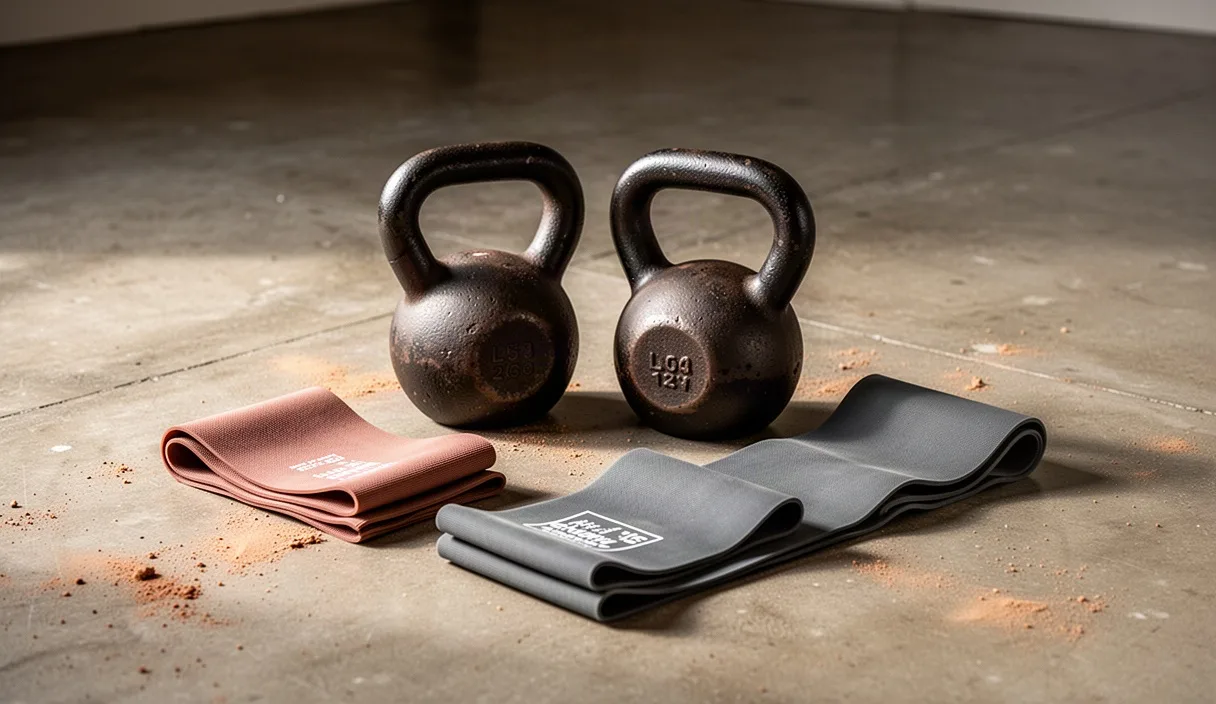

Free weights rely on gravity. An iron mass pulls straight toward the floor. A barbell loaded with 40 kilograms requires 40 kilograms of upward force at every point of the lift. The path of motion remains vertical relative to the earth.
Resistance bands rely on material deformation. An elastic loop produces tension only when stretched. The force vector follows the anchor point rather than gravity. This mechanical difference alters muscle recruitment, joint pressure, and training logistics.
Mechanical differences in resistance curves
A dumbbell provides constant mass. The internal muscular force required to move it changes throughout a movement. This shift occurs because joint angles alter the length of the moment arm. In a standing bicep curl, the forearm reaches 90 degrees of flexion relative to the upper arm. The moment arm peaks at this horizontal position. The movement feels heaviest here. At the bottom and top of the curl, the moment arm shortens. The mechanical demand on the muscle drops.
A resistance band provides ascending resistance. The band follows Hooke-type mechanical behavior. As the material elongates, tension climbs. At the start of a banded bicep curl, the band hangs with minimal stretch. The initial pull requires modest force. As the hands approach shoulder height, the rubber stretches to double its resting length. Tension reaches peak output at the exact end of joint range.
The combination of these curves changes muscle stimulation. Free weights test the muscle at its longest or mid-range positions. Bands test the muscle primarily at its shortened position. Deceleration demands also diverge. Free weights carry inertia. A lifter must decelerate a fast-moving dumbbell near the end of a range to protect the joint. A band creates natural deceleration. The rising elastic tension slows the limb automatically before lockout.
| Metric | Free weights | Resistance bands |
|---|---|---|
| Primary resistance source | Gravity acting on mass | Material elongation |
| Force direction | Strictly vertical | Along the line of pull |
| Peak loading point | Longest moment arm | Maximum stretch distance |
| Inertia contribution | High during rapid reps | Near zero |
| Eccentric overload | Consistent throughout drop | Decreases as band shortens |
Neither profile replaces the other. Free weights build force production in stretched positions. Stretched positions correlate strongly with tissue hypertrophy. Bands build terminal lockout force without inertia. They allow lateral, diagonal, and rotational loading angles that iron cannot match without pulleys.
Joint stress during overhead movements
The shoulder complex balances high mobility against low passive stability. Overhead pressing with free weights exposes this joint to heavy loads in compromised ranges. At the bottom of a dumbbell overhead press, the humeral head sits deep in the glenoid fossa under direct downward load. If thoracic spine extension is limited, the subacromial space narrows. The supraspinatus tendon experiences direct compression under full iron weight.
Resistance bands alter this loading pattern. At the start of an overhead press, the band sits at roughly 42 inches of length with low elongation. Tension remains light near the collarbones. As the arms extend upward, the joint moves into a structurally stacked position. The elbows lock out. The spine supports the skeleton. The band reaches maximum elongation and maximum resistance precisely where the bones bear the load.
This dynamic reduces shearing force at the bottom of the movement. Individuals with shoulder impingement often tolerate banded pressing better than iron pressing. The band demands stability without inflicting heavy bottom-range torque. However, bands introduce higher demands on terminal stabilization. The user must stabilize against vibrating, multidirectional elastic pull at full extension.
- Dumbbell press: Peak tendon shear occurs at collarbone height.
- Dumbbell press: Momentum can mask weak lockout mechanics.
- Banded press: Peak muscular load occurs at full overhead lockout.
- Banded press: Unstable band oscillation requires active rotator cuff engagement.
Pain during overhead movement warrants a formal assessment. Consult a physical therapist or medical physician to diagnose structural impingement, labral tears, or bursitis before selecting either tool for overhead rehab.
Storage and convenience for home spaces
A dedicated free weight setup occupies measurable square footage. A standard pair of adjustable dumbbells with a stand requires roughly 6 square feet of floor space. A standard power rack, barbell, and iron plates require at least 48 square feet. Total iron weight for an intermediate lifter often exceeds 180 kilograms. Floors in standard residential apartments must support this static load. Dropping a 24-kilogram dumbbell cracks tile and indents subfloors.
A complete set of loop resistance bands weighs under 2 kilograms. Four continuous-loop bands of varying widths fit inside a single 10-inch drawer. They generate zero floor impact. Training can occur on hardwood, carpet, or vinyl without protective rubber mats. Noise output remains minimal. There is no clanking of iron collars or rattling of weight plates.
Bands present specific environmental vulnerabilities. Natural latex degrades under ultraviolet light. Storing bands near a window dries the rubber. Cold environments reduce elastic flexibility and increase snap risks. Free weights require temperature control only to prevent surface rust. Cast iron lasts decades with zero maintenance. A heavily used latex band requires replacement after 18 to 24 months of regular stretch cycles.
Anchor points dictate band functionality in home settings. Free weights operate anywhere flat ground exists. Bands require rigid attachment points for horizontal rows, chest presses, and leg curls. A door anchor offers basic utility. A door anchor exerts pulling force on the door frame hinges. Structural studs or dedicated wall plates provide safer anchors for heavy thick-loop bands.
Progressive overload tracking methods
Free weights offer straightforward numeric tracking. A lifter writes down kilograms and repetitions. If an athlete presses 20 kilograms for 8 reps this week, they attempt 22 kilograms next week. The load increases in exact, verified increments. Plate manufacturers calibrate iron to tight tolerances. Progress remains visible and binary.
Resistance bands complicate progressive overload. Band ratings indicate broad ranges rather than fixed numbers. A single band might read 15 to 35 kilograms. This means 15 kilograms of resistance at 1.5 times resting length, and 35 kilograms at 2.5 times resting length. Changing foot stance width by 3 inches changes band elongation. That small adjustment alters load without changing the band itself.
- Standardize stance width. Place masking tape on the floor. Step on identical floor marks for every set of squats or curls.
- Track resting anchor distance. Measure the exact space between the anchor point and your body using a standard tape measure.
- Count repetition cadence. Lower the band for 3 seconds. Hold the lockout for 2 seconds. Controlled tempo prevents elastic snapback from distorting work volume.
- Introduce micro-bands. Add a thin 0.25-inch band alongside a 1-inch band instead of jumping directly to a heavy 1.75-inch band.
Another tracking method uses a digital luggage scale. Connect the scale between the band and the handle. Pull to the designated end point and read the digital readout. This provides an exact peak tension number for the training log.
A combined weekly training protocol
Combining iron and elastic resistance balances resistance curves. Free weights train the stretched position. Bands overload the contracted position. The following three-day protocol uses both tools across a full-body structure. Rest 48 hours between training sessions.
Session Monday: Lower body focus
Perform the movements in order. Rest 90 seconds between sets.
- Goblet squat with dumbbell: 3 sets of 8 reps. Control the 3-second descent.
- Banded Romanian deadlift: 3 sets of 12 reps. Stand on a 1.5-inch loop band. Drive hips forward against increasing tension.
- Dumbbell walking lunge: 3 sets of 10 steps per leg. Use moderate weight.
- Standing banded lateral walk: 3 sets of 15 steps per side. Place a mini-band around the forefeet.
Session Wednesday: Upper body push and pull
Alternate push and pull exercises to preserve local muscular endurance.
- Flat dumbbell bench press: 3 sets of 8 reps. Pause for 1 second at chest level.
- Banded horizontal row: 3 sets of 12 reps. Anchor band at chest height. Squeeze shoulder blades at full contraction for 2 seconds.
- Standing banded overhead press: 3 sets of 10 reps. Step inside a 1-inch band. Press upward to full elbow extension.
- Dumbbell single-arm row: 3 sets of 10 reps per side. Keep torso parallel to the floor.
- Overhead banded tricep extension: 2 sets of 15 reps. Step on the band and press upward behind the head.
Session Friday: Hybrid movement and trunk
Combine tools within single exercises to challenge stability and variable loads.
- Dumbbell Romanian deadlift: 3 sets of 8 reps with iron plates.
- Band-resisted push-up: 3 sets of 10 reps. Wrap a light band across the upper back and hold the ends under the palms.
- Dumbbell hammer curl: 3 sets of 10 reps. Control the lowering phase completely.
- Banded face pull: 3 sets of 15 reps. Anchor band at eye level. Pull toward forehead with elbows high.
- Banded Pallof press: 3 sets of 12 reps per side. Hold each forward extension for 3 seconds against lateral pull.
Common mistakes
Allowing slack at the bottom of a band movement ruins tension. If the band dangles loosely at the lowest point of a curl or row, the muscle receives zero load for part of the range. Shorten the resting band length before initiating the repetition.
Dropping free weights quickly through the eccentric phase wastes half the movement. Gravity pulls the dumbbell down. If the lifter drops with it, mechanical tension disappears. Lower the iron under strict muscular control.
Relying on band color across different brands causes load errors. A red band from one manufacturer often delivers 12 kilograms of peak tension. A red band from another manufacturer delivers 23 kilograms. Track bands by width in inches or millimeters rather than color.
Using worn bands creates injury risks. Small tears appear along band edges near anchor contacts. Inspect the latex before every workout. Pull the band gently under light tension and check for pinholes or surface peeling. Discard compromised bands immediately.
Next steps for implementation
Audit your available space first. Measure your clear floor area. If you possess less than 15 square feet of dedicated room, acquire a four-piece set of loop resistance bands and a doorway anchor. If you have permanent space and solid flooring, acquire a pair of adjustable dumbbells that scale to at least 24 kilograms per hand.
Test your joint status next. Perform an unweighted overhead reach against a wall. If your ribs flare or shoulders pinch, start overhead loading with light bands rather than heavy dumbbells. Introduce load gradually.
Select your recording system. Buy a physical notebook or open a plain text file. Write down the tool, the specific band width or dumbbell weight, the repetition count, and the exact anchor or stance dimensions. Maintain these baseline numbers for four weeks before altering volume.